What is the spinal disc?
The spinal disc is a soft cushion that sits between each vertabrae of the spine. This spinal disc becomes more rigid with age. In a young individual, the disc is soft and elastic, but like so many other structures in the body, the disc gradually looses its elasticity and is more vulnerable to injury. In fact, even in individuals as young as 30, MRIs show evidence of disc deterioration in about 30% of people.
What happens with a ‘herniated disc’?
As the spinal disc becomes less elastic, it can rupture. When the disc ruptures, a portion of the spinal disc pushes outside its normal boundary–this is called a herniated disc. When a herniated disc bulges out from between the vertebrae, the spinal nerves and spinal cord can become pinched. There is normally a little extra space around the spinal cord and spinal nerves, but if enough of the herniated disc is pushed out of place, then these structures may be compressed.
What causes symptoms of a herniated disc?
When the herniated disc ruptures and pushes out, the nerves may become pinched. A herniated disc may occur suddenly in an event such as a fall or an accident, or may occur gradually with repetitive straining of the spine. Often people who experience a herniated disc already have spinal stenosis, a problem that causes narrowing of the space around the spinal cord and spinal nerves. When a herniated disc occurs, the space for the nerves is further diminished, and irritation of the nerve results.
What are the symptoms of a herniated disc?
When the spinal cord or spinal nerves become compressed, they don’t work properly. This means that abnormal signals may get passed from the compressed nerves, or signals may not get passed at all. Common symptoms of a herniated disc include:

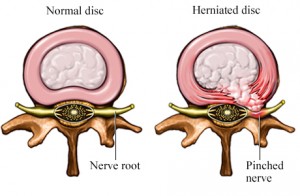
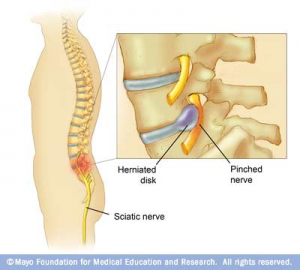 All of these symptoms are due to the irritation of the nerve from the herniated disc. By interfering with the pathway by which signals are sent from your brain out to your extremities and back to the brain, all of these symptoms can be caused by a herniated disc pressing against the nerves.